
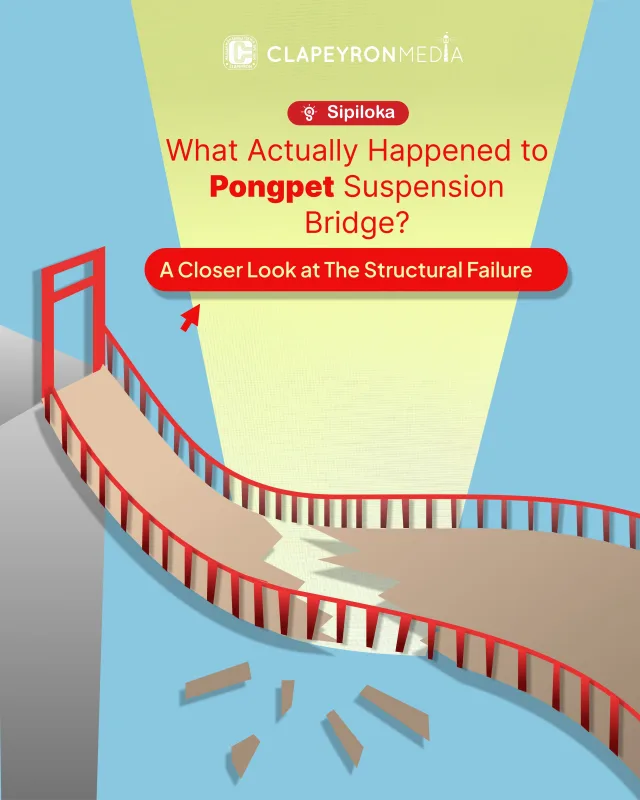
A newly launched bridge would normally be a symbol of progress. However, for the Pongpet Suspension Bridge in Pangandaran, West Java, its launch on Sunday, August 30, 2026, ended with an unexpected structural incident. At around 4:10 PM, shortly after the launching ceremony, the bridge suddenly tilted while a large group of people was crossing. Several people lost their balance and fell, including Pangandaran Regent Citra Pitriyami, Head of the Pangandaran Public Works Agency, Ling Ling Nugraha Senjaya, and Pangandaran Military District Commander Lieutenant Colonel Czi Citra Kurniawan.
The incident was initially widely described as the bridge “collapsing” or “breaking.” But what really happened? The answer was far more complicated. According to a clarification from the Indonesian Army, the main structure of the Pongpet Suspension Bridge did not completely collapse. Instead, a suspension cable on the left side of the bridge became detached from its main anchorage system. This caused the bridge deck to tilt, making people on the bridge lose their balance and fall.
This distinction matters because, in structural engineering, a failure does not necessarily mean that an entire structure has collapsed. A bridge consists of multiple components that work together to carry and transfer loads. The failure or detachment of one critical component can change the behavior of the entire system, even when the main structure is still standing.
In the case of Pongpet, the main cable was still held by the saddle at the top of the pylon. Because of this, the bridge did not experience a total structural collapse. However, the loss of support on one side was enough to compromise its stability.
So, what really caused the Pongpet Suspension Bridge to fail? The initial explanation points to one major factor: excessive loading. More than 50 people were reportedly crossing the bridge at approximately the same time after the launching ceremony. The Ministry of Public Works’ initial technical inspection indicated signs of excessive loading on several structural elements, including the lower supporting cables, hanger elements, and one of the anchorage blocks.
A large number of people on the bridge meant that the structure was subjected to a different loading condition from the one during its earlier tests. Therefore, the incident was not simply a matter of the bridge “breaking.” Rather, the sudden increase in the number of people on the bridge placed greater demands on its structural system, contributing to the failure of the suspension cable.
One of the most striking details of the case is that the bridge had already been tested before its launch. Approximately one week earlier, the bridge was tested using two motorcycles and six people and was declared safe. During the launching, however, the situation was very different. A much larger group of people crossed the bridge at the same time, creating a loading condition far beyond that of the earlier test.
This raises an important question: what does it actually mean for a bridge to “pass” a test? A structural test provides information about how a structure behaves under a particular set of conditions. In Pongpet, the earlier test involved only two motorcycles and six people. On the other hand, the launching placed dozens of people on the bridge simultaneously. The two situations, therefore, cannot be treated as equivalent.
A bridge may perform satisfactorily during a limited test while responding differently when the number of people, the distribution of load, or the way the structure is being used changes substantially. This is why structural safety cannot be judged solely by whether a structure remained standing during one test.
A structure’s safety does not end when construction is completed or when an initial test is passed. There must also be an understanding of how the structure is expected to operate and what conditions could place excessive demands on its components.
For a suspension bridge, this is particularly important because different elements work together as a system. Cables, hangers, anchorages, pylons, and the deck each have their own roles, but their performance is interconnected. Therefore, the failure of a single critical connection can affect the stability of the entire bridge. The Pongpet incident illustrates this relationship clearly. The main structure remained standing, yet the detachment of one suspension cable was enough to cause the bridge deck to tilt and create a dangerous condition for those on it.
So, what actually happened to the Pongpet Suspension Bridge? It was not a complete collapse; rather, a critical part of the structural system failed when the bridge was subjected to a much greater loading condition than during its previous test. The incident shows that when looking at structural safety, it is not enough to ask whether a bridge can stand. We also have to look at how its components work together and how the structure will actually be used.
Written by Keesha Rygel
Data by Tiefani Kunti Areyane
Layout by Khairani Ludwina